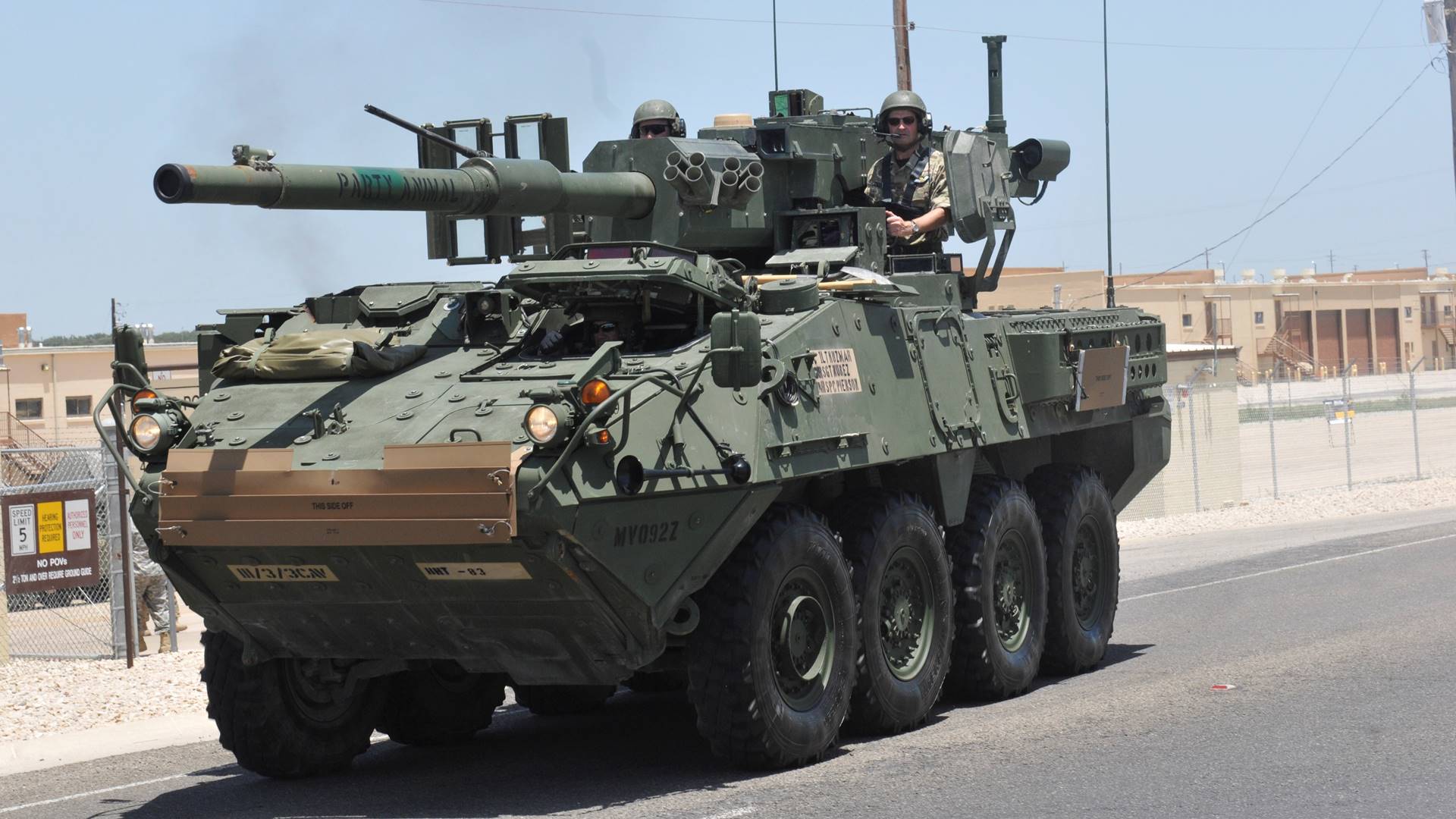
Throughout its operational lifespan, the Stryker Combat Vehicles has undergone a series of enhancements that have improved its capacity to endure hostile attacks. These upgrades have included the implementation of various “kit” applications that have been specifically designed to increase the vehicle’s overall resilience.
The Stryker, which was first introduced shortly after the turn of the millennium, is an eight-wheeled armored combat vehicle that utilizes an all-wheel drive system. It is produced by General Dynamics Land Systems and is based on the Canadian Light Armored Vehicle III.
When compared to other vehicles in its class such as the Bradley Fighting Vehicles or M-1 Abrams Main Battle Tank, the Strykers are relatively lightweight and capable of achieving higher speeds. Additionally, the Stryker can be transported via a C-5 Galaxy that can accommodate seven vehicles, a C-17 Globemaster III that can transport up to four vehicles, or a C-130 Hercules cargo plane that can carry a single Stryker.
The Stryker’s chassis boasts a modular design that is capable of supporting a wide array of variations. The Infantry Carrier Vehicle represents the primary chassis configuration.

Yes, the Stryker’s modular design allows for a wide range of variants to be developed based on a common chassis. This design approach allows for a high degree of flexibility, as the same basic chassis can be configured in different ways to meet specific mission requirements. The Stryker’s chassis can be outfitted with different weapons, sensors, and other equipment, as well as different types of armor, depending on the variant. The modular design also allows for easy maintenance and upgrade, as components can be easily swapped out or replaced as needed.
The Stryker Family of Vehicles is built on a common chassis, with some variants having different Mission Equipment Packages. There are 18 variants; 10 flat-bottom variants that include the M1126, M1128, M1127, M1129, M1130, M1131, M1132, M1133, M1134, and M1135; seven Double-V-Hull variants for the following; Infantry Carrier Vehicle, Commander’s Vehicle, Medical Evacuation Vehicle, Mortar Carrier, Anti-tank Guided Missile, Fire Support Vehicle, and Engineer Squad Vehicle, and an additional configuration of a modified Infantry Combat Vehicle platform integrating a 30 mm cannon.
America’s 18 Different Types of Stryker Combat Vehicles
M1126 Infantry Carrier Vehicle

The M1126 Stryker is a basic armored personnel carrier that offers protected transport for two crew members and a nine-man infantry squad while supporting dismounted infantry. Weighing 19 tons, it features a communication system that allows for text and map network between vehicles. Upgraded models with the double V-hull are known as the M1256.
The Stryker is equipped with a Protector remote weapon station, which has a universal soft mount cradle that can accommodate either a .50 caliber M2 Browning machine gun, a 40mm Mark 19 grenade launcher, or a 7.62x51mm NATO M240 machine gun. Additionally, it comes equipped with four M6 smoke grenade launchers.
M1127 Reconnaissance Vehicle

The M1127 Reconnaissance Vehicle is a wheeled armored personnel carrier that belongs to the Stryker family and is currently used by the US Army.
This vehicle is primarily used by reconnaissance, surveillance, and target acquisition squadrons as well as battalion scouts who move throughout the battlefield to gather and transmit real-time intelligence and surveillance data. The M1127 plays a crucial role in providing situational awareness and improving the brigade’s decision-making abilities, allowing it to anticipate and avert threats and enabling greater freedom of maneuver on the battlefield.
M1128 Mobile Gun System

The M1128 Mobile Gun System is a variant of the Stryker family of combat vehicles armed with a 105 mm cannon, a coaxially mounted 7.62 mm M240 machine gun, a .50 caliber machine gun, and two M6 smoke grenade launchers.
The low-profile, fully stabilized turret of the eight-wheeled Stryker vehicle carries a General Dynamics 105mm tank cannon that can fire on the move. It provides direct fire support to infantry and engages stationary and mobile enemy targets, such as bunkers, to create a combined arms effect of overmatched firepower, improving the survivability of the combat team.
The M1128 can fire 18 rounds of 105-mm main gun ammunition, 400 rounds of .50 caliber ammunition, and 3,400 rounds of 7.62-mm ammunition. It is also equipped with M6 smoke grenade launchers and operates with the latest Command, Control, Communications, Computers Intelligence, Surveillance, and Reconnaissance (C4ISR) equipment, as well as detectors for nuclear, biological, and chemical weapons.
The Mobile Gun System vehicle is a strengthened variant of the Light Armoured Vehicle III, retaining commonality across all vehicles in the Stryker family. However, the M1128 Stryker was retired at the end of 2022, partly due to the expense and difficulty of maintaining and upgrading the autoloader.
M1129 Mortar Carrier

The M1129 Mortar Carrier is an 8×8 wheeled armored vehicle that belongs to the Stryker family of combat vehicles and is currently in use with the United States Army. Upgraded models with the double V-hull are known as the M1252.
Equipped with an M121 120 mm mortar, the M1129 can fire a range of ammunition, including high explosive, precision-guided, dual-purpose, smoke, illumination, and infrared illumination shells. The mortar is mounted within the vehicle and fires through roof hatches that swing open at the top.
In addition to the M121 mortar, the M1129 carries the 81mm M252 mortar, which can only be used in a dismounted capacity.
M1130 Commander’s Vehicle

The M1130 Stryker is an armored command vehicle based on the Stryker platform. It is used within the brigade to provide a means to receive, analyze, and transmit information, and to control forces carrying out combat missions. Models with the double V-hull upgrade are known as the M1255.
The M1130 provides an operational platform for command elements within the Stryker Brigade Combat Team. It is equipped with the ability to access aircraft power and antenna systems, allowing for mission planning while en route aboard aircraft.
M1131 Fire Support Vehicle

The M1131 Stryker provides automated, enhanced surveillance, target acquisition, identification, tracking, designation, position location, and communication capabilities. Targets can be instantly transmitted to the fire support system and shooter. Models with the double V-hull upgrade are known as the M1251.
As the M1131 Stryker is primarily designed for target tracking and identification, the Army is integrating a directed energy weapon onto the vehicle, called the Mobile Expeditionary High Energy Laser, to defend against small and medium-sized unmanned aerial vehicles.
M1132 Engineer Squad Vehicle

The M1132 is a variant of the Stryker armored fighting vehicle designed for combat engineering. The vehicle is used to transport and support combat engineers on the battlefield, and includes obstacle clearing and lane marking systems as well as mine detection devices.
Based on the infantry carrier, the M1132 features a distinctive mine-clearance blade and is often accompanied by a wheeled trailer loaded with additional equipment. It is capable of clearing mines on paved surfaces and can perform some rubble clearance tasks. The vehicle’s mounted engineer squad is also equipped with tools from the trailer to complete other mobility tasks. The M1257 is a version of the M1132 with a double V-hull upgrade.
M1133 Medical Evacuation Vehicle

The Medical Evacuation Vehicle are assigned from the Battalion Aid Station for Battalion-sized units, and dedicated to each of the company-sized elements of the unit and provide treatment for serious injury and advanced trauma cases. Models with the double V-hull upgrade are known as the M1254.
The Medical Evacuation Vehicle is the primary ambulance platform in units equipped with the Stryker family of vehicles.
M1134 Anti-Tank Guided Missile

The M1134 ATGM Vehicle is an armored fighting vehicle from the Stryker family of vehicles, and is used by the US as an anti-tank missile carrier. Its purpose is to provide the brigade’s main tank-killing capability by firing heavy anti-tank missiles to defeat enemy armored vehicles at range, before the enemy tanks can return fire. Models with the double V-hull upgrade are known as the M1253.
The General Dynamics Land Systems remote ATGM system for tracked and wheeled infantry fighting vehicles evolved from the Elevated TOW system. The ATGM weapon system gives TOW missile capability to today’s infantry fighting vehicles. It has a 2-tube launcher and an elevated mast extending 0.5 meters above the chassis. The crew of three is under armor at all times, providing maximum crew protection when operated stealthily using terrain and other structures to provide masking and protection. The ATGM weapon system, through the employment of current sighting technologies, enables the use of the family of all TOW missile types.
M1135 Nuclear, Biological, Chemical, Reconnaissance Vehicle (NBC RV)

The M1135 is a vehicle that provides nuclear, biological, and chemical detection and surveillance for hazard visualization on the battlefield. It automatically integrates contamination information from detectors with input from navigation and meteorological systems and transmits digital NBC warning messages to warn follow-on forces. The core of the NBC RV is its onboard integrated sensor suite and integrated meteorological system.
The M1135 features a positive overpressure system that minimizes cross-contamination of samples and detection instruments, provides crew protection, and allows extended operations at MOPP 0. As of 2010, the U.S. Army did not plan to field Stryker Double V-Hull versions of the NBCRV.
Over the years, the Army has continued to update Strykers. In 2017, two new Stryker variants were fielded after a two-year initiative designed to give them far more firepower and engagement range. These qualities were deemed necessary to confront Russian armored vehicles equipped with heavier weapons than the Infantry Carrier Vehicle’s 50-cal machine gun.

One of the new variants, dubbed the “Dragoon” like its 2nd Cavalry Regiment owners, was armed with a 30mm Bushmaster cannon. The design also uses the latest tech from other Stryker models, including the suspension from the “Double-V” ambush and mine-resistant Stryker’s hull, and mature combat system components.
In April 2021, the Army fielded the mobile short-range air defense (M-SHORAD) variant. In October 2021, General Dynamics Land Systems announced a formal partnership deal with Epirus on a drone-zapping Stryker variant that would integrate Epirus’s Leonidas high-power microwave weapon into the vehicle.
According to Epirus, that vehicle, dubbed the Stryker Leonidas, passed a key test in October 2022, disabling drones and swarms of drones.